Introduction
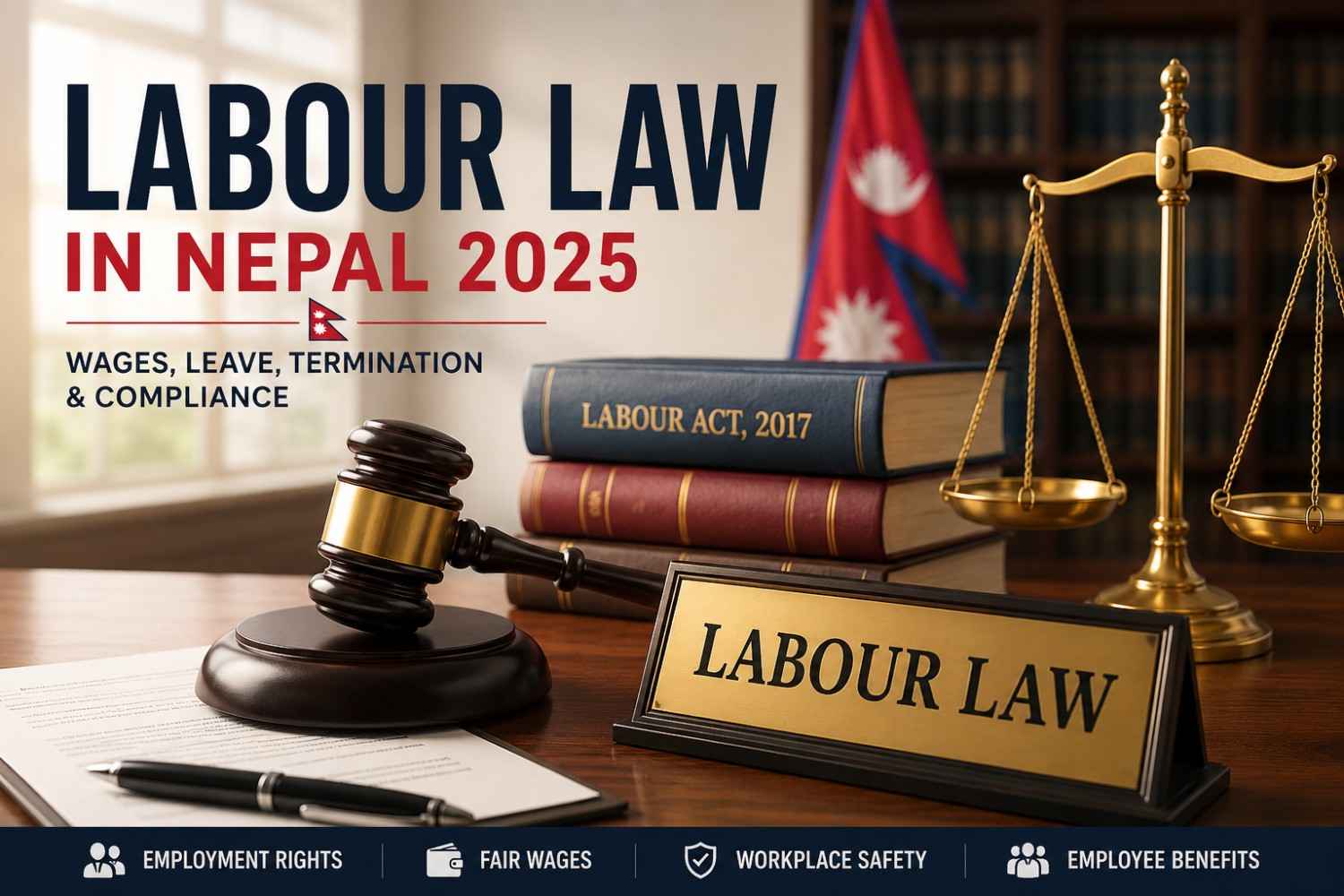
The Labour Act, 2017 (2074 BS) is the principal legislation regulating employment relationships in Nepal. The law governs the rights and duties of employers and employees, including wages, working hours, leave, workplace safety, termination procedures, and social security obligations.
The Act applies to most businesses and organizations operating in Nepal, including companies, partnerships, NGOs, startups, and foreign-invested enterprises. Over the years, Nepal’s labour regime has shifted toward stronger employee protection and stricter compliance requirements for employers.
For businesses operating in Nepal, understanding labour law is essential to avoid legal disputes, penalties, and operational risks.
Applicability of the Labour Act, 2017
The Labour Act applies broadly to almost all entities operating in Nepal, regardless of profit motive or business size.
Covered entities generally include:
- Companies and private firms
- Partnerships and cooperatives
- NGOs and INGOs
- Service-oriented businesses
- Foreign companies operating in Nepal
Unlike the previous labour law, the current Act applies even where an entity employs fewer than 10 workers. However, some procedural obligations, such as collective bargaining committees, become mandatory only in larger workplaces.
Certain categories remain outside the scope of the Act, including civil servants, members of the armed forces, diplomatic missions, and employees governed by special laws.
Types of Employment in Nepal
Nepal labour law recognizes multiple categories of employment depending on the nature and duration of work.
| Employment Type | Description |
| Regular Employment | Permanent and continuous employment |
| Time-Based Employment | Employment for a fixed period |
| Work-Based Employment | Employment tied to a specific task or project |
| Casual Employment | Work for 7 days or less within a month |
| Part-Time Employment | Work below 35 hours per week |
Part-time employees are also entitled to proportional wages and social security benefits under the law.
The Act additionally permits hiring of interns and trainees under specific legal conditions.
Working Hours and Minimum Wage
Under Nepal labour law, employees generally cannot be required to work more than:
- 8 hours per day
- 48 hours per week
Employees are entitled to rest breaks, and overtime work is regulated by law. Overtime cannot generally exceed 24 hours per week.
Women employees working before sunrise or after sunset must be provided transportation arrangements by the employer.
Minimum Wage in Nepal (2025)
The current minimum wage structure includes:
Monthly minimum wage: NPR 19,550
Basic wage : NPR 12,170
Dearness allowance : NPR 7,380
Hourly Wage: NPR 107
Employers must comply with minimum wage standards fixed by the Government of Nepal.
Leave and Employee Benefits
Employees in Nepal are entitled to several forms of paid leave and statutory benefits.
Key Leave Provisions
- Weekly leave: 1 day per week
- Public holidays: 13 days annually
- Sick leave: 12 days paid leave
- Home leave: 1 day for every 20 working days
- Maternity leave: 14 weeks
- Paternity leave: 15 days paid leave
Female employees are entitled to paid maternity benefits as provided under the Labour Act.
Employees are also entitled to a festival allowance equivalent to one month’s basic salary each year.
Unused home leave and sick leave may be encashed subject to statutory limitations.

Social Security and Employer Obligations
The Labour Act and Social Security laws require employers to contribute toward employee benefits and welfare schemes.
| Benefit | Requirement |
| Provident Fund | 10% contribution by employer and employee |
| Gratuity | 8.33% of basic salary |
| Medical Insurance | Minimum NPR 100,000 coverage |
| Accident Insurance | Minimum NPR 700,000 coverage |
Employers are also required to maintain workplace safety standards, provide protective equipment where necessary, and implement health and safety measures.
Businesses employing 20 or more workers are generally required to establish a health and safety committee.
Termination of Employment
Employment may only be terminated according to procedures established under labour law.
Lawful Grounds for Termination
- Voluntary resignation
- Expiry of fixed-term contract
- Poor performance
- Medical incapacity
- Retirement
- Serious misconduct
Serious misconduct may include theft, fraud, workplace violence, unauthorized disclosure of confidential information, or sexual harassment.
Notice Period Requirements
The required notice period depends on the duration of employment:
- Up to 4 weeks: 1 day notice
- 4 weeks to 1 year: 7 days notice
- More than 1 year: 30 days notice
Where proper notice is not provided, compensation in lieu of notice may become payable.
Why Labour Law Compliance Matters
Non-compliance with labour laws in Nepal can result in:
- Financial penalties
- Labour disputes
- Compensation claims
- Reputational damage
- Operational interruption
Businesses should ensure that employment contracts, HR policies, workplace rules, and termination procedures comply with Nepalese labour law requirements.
Legal consultation is particularly important for startups, foreign investors, and growing businesses managing larger workforces.
Conclusion
The Labour Act, 2017 governs employment relationships in Nepal and sets out important rules relating to wages, working hours, leave, social security, workplace safety, and termination of employment. Employers must ensure compliance with labour laws to avoid disputes, penalties, and legal liabilities, while employees should understand their statutory rights and protections under Nepalese law.
Non-compliance with Nepal’s labour law can lead to heavy fines, litigation, operational disruption, and reputational damage. Employers, startups, and foreign investors are advised to seek professional legal guidance for employment structuring, HR compliance, and dispute resolution.
FAQs on Labour Law in Nepal
Is an employment contract mandatory in Nepal?
Yes. Employers are generally required to provide employees with an employment contract or appointment letter.
What is the minimum wage in Nepal in 2025?
The current minimum monthly wage is NPR 19,550.
Can an employer terminate an employee without notice?
Generally, employers must provide notice or compensation unless termination is based on serious misconduct.
Are foreign companies subject to Nepal labour law?
Yes. Foreign businesses operating or employing workers in Nepal must comply with Nepal labour laws.
Is overtime allowed under Nepal labour law?
Yes. However, overtime is regulated and subject to statutory limits.
Are employees entitled to gratuity and provident fund?
Yes. Employers must contribute toward gratuity and provident fund in accordance with the law.