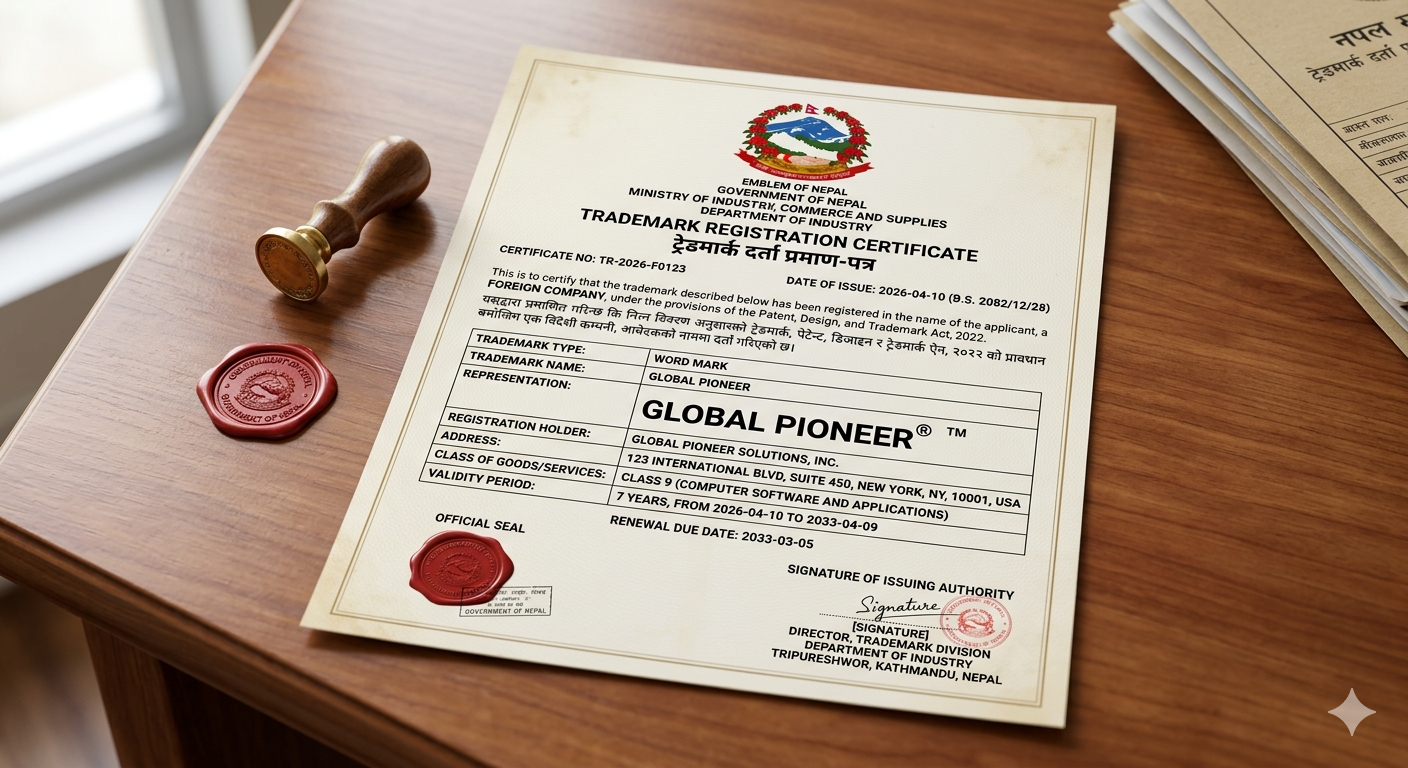
Protecting your brand in Nepal requires proper legal registration. Foreign trademark registration in Nepal is governed by the Patent, Design and Trademark Act 1965 (PDTA), which follows a strict registration-based system. This means that even globally recognized brands must register their trademarks in Nepal to obtain legal protection.
This article provides a complete guide on the foreign trademark registration process in Nepal, required documents, legal framework, timeline, and fees, tailored for international businesses and brand owners.
What is a Foreign Trademark?
A trademark is a word, logo, symbol, or combination that distinguishes goods or services of one business from another. A foreign trademark refers to a mark that is already registered or applied for in another country and is now seeking protection in Nepal.
Is Trademark Registration Mandatory for Foreign Brands in Nepal?
Yes. Nepal follows a “first-to-register” principle, meaning:
- Trademark rights are granted only after registration
- Prior use or international reputation does not guarantee protection
- Even well-known foreign brands must register locally
Without registration, legal enforcement against infringement in Nepal is extremely limited.
Governing Law and Authority
Applicable Law
Foreign trademark registration is regulated under the:
Competent Authority
All trademark registrations are handled by the Department of Industry (DOI) under the Government of Nepal.
The DOI is responsible for:
- Registration and certification
- Examination and publication
- Handling opposition cases
- Maintaining trademark records
Eligibility for Foreign Trademark Registration in Nepal
To register a foreign trademark in Nepal, the applicant must have:
- A Home/Foreign Trademark Registration Certificate, OR
- A pending trademark application in another country
Priority Claim
Under international practice, applicants can claim priority within 6 months of filing in another country.
Step-by-Step Process of Foreign Trademark Registration in Nepal
This is the most searched part, here’s the practical process your clients want:
Step 1: Trademark Search (Recommended)
Before filing, conduct a search to ensure the mark is not already registered or similar to an existing trademark.
Step 2: Filing Application at DOI
Submit the application with required documents to the Department of Industry.
The application must include:
- Applicant details
- Trademark label/logo
- Class of goods/services
Step 3: Examination by DOI
The DOI reviews the application to check:
- Similarity with existing trademarks
- Compliance with legal requirements
- Distinctiveness of the mark
Step 4: Publication in IP Bulletin
If accepted, the trademark is published in the Industrial Property Bulletin (IP Bulletin) for public notice.
Step 5: Opposition Period (90 Days)
Any third party can file opposition within 90 days of publication.
Step 6: Registration and Certificate Issuance
If no opposition is filed (or successfully defended), the trademark is registered and a certificate is issued.
Documents Required for Foreign Trademark Registration
The following documents are required:
- Application form (original)
- Home/Foreign Registration Certificate (notarized)
- Trademark label/logo (4 copies, color)
- Power of Attorney
- Board Resolution (for companies, if applicable)
Important:
- Foreign documents must be translated into English
- Notarization is required for foreign certificates
Grounds for Refusal of Trademark in Nepal
The DOI may reject a trademark application if it:
- Is identical or confusingly similar to an existing trademark
- Damages the reputation or goodwill of another brand
- Is misleading or deceptive
- Violates public morality or national interest
- Is already registered by another party
Trademark Opposition Process in Nepal
After publication, any person can oppose the trademark.
Common Grounds for Opposition:
- Lack of distinctiveness
- Similarity with existing marks
- Misleading or deceptive nature
- Reputation conflict
Opposition is handled administratively by the DOI and may be appealed to higher courts.
Timeline for Foreign Trademark Registration in Nepal
| Process Stage | Time |
| Without opposition | 4-6 months |
| With opposition | 1-2 years (more) |
Validity and Renewal of Trademark
- Initial validity: 7 years
- Renewable indefinitely for 7-year periods
Renewal Rules:
- Must renew before 35 days of expiry
- Late renewal allowed within 6 months with penalty (NPR 1,000)
Failure to renew may result in cancellation.
Trademark Classification in Nepal
Nepal follows the Nice Classification system, which includes:
- 45 total classes (Goods + Services)
- Separate application required for each class
- Separate government fee per class
Government Fees for Trademark Registration
- Application Fee: NPR 1,000
- Registration Fee: NPR 5,000
Benefits of Registering a Foreign Trademark in Nepal
1. Legal Protection
Prevents unauthorized use and infringement.
2. Exclusive Rights
Grants the owner exclusive rights to use the trademark in Nepal.
3. Brand Protection
Safeguards brand identity and reputation in the Nepali market.
4. Business Expansion
Supports international business growth and market entry in Nepal.
Important Practical Tips
- Always conduct a prior trademark search
- Ensure consistency in documents and trademark representation
- File under correct class/category
- Respond promptly to DOI queries
- Monitor IP Bulletin for potential opposition
Conclusion
Foreign trademark registration in Nepal is essential for brand protection. Despite Nepal’s participation in international treaties, local registration remains mandatory for enforcement.
Understanding the registration process, documentation, and legal requirements ensures smooth approval and long-term protection of your brand in Nepal.
Need assistance with foreign trademark registration in Nepal?
Surya Law https://suryalawfirmnepal.com.np/Firm Nepal provides complete legal services including trademark search, filing, opposition handling, and enforcement for international clients.