Introduction
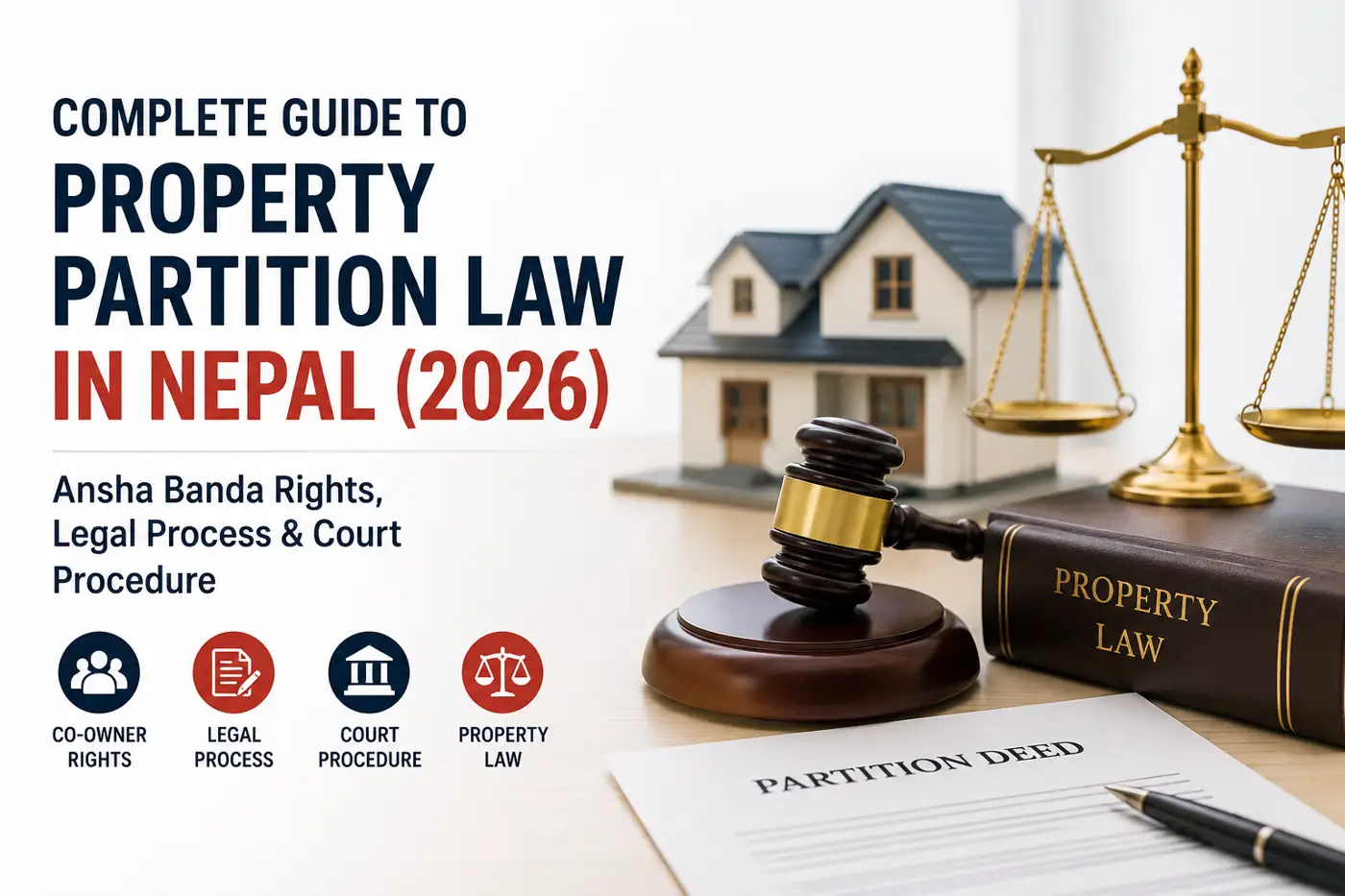
Property partition in Nepal, commonly known as Ansha Banda (अंशबण्डा), is one of the most common legal matters involving family property, inheritance rights, and division of ancestral assets among family members. With the introduction of the Muluki Civil Code 2074 (2017), Nepal significantly reformed property laws by ensuring equal rights for sons and daughters, including married daughters.
Family property disputes in Nepal frequently arise due to unclear ownership, hidden property, disagreements among siblings, or denial of legal shares. Understanding the legal process of property partition is therefore essential to avoid prolonged disputes and future litigation.
This article explains the legal meaning of Ansha Banda, rights of coparceners, partition procedures, court process, important legal provisions, and frequently asked questions under Nepali law.
What Is Property Partition (Ansha Banda) in Nepal?
Property partition refers to the legal division of ancestral or jointly owned family property among legally entitled family members. Once partition is completed, each person becomes the independent owner of their allocated share.
Property subject to partition may include:
- Land and plots
- Houses and buildings
- Agricultural property
- Bank deposits and cash
- Business ownership
- Rental income properties
- Vehicles and movable assets
Under Nepali law, partition can occur either:
- Through mutual family agreement, or
- Through court order when disputes arise.
Governing Laws of Property Partition in Nepal
The primary law governing property partition in Nepal is the Muluki Civil Code 2074. Other laws also play important roles in ownership, transfer, and inheritance matters.
| S.N. | Law | Major Provisions |
| 1 | Constitution of Nepal 2072 | Guarantees property rights and equal lineage rights for women |
| 2 | Muluki Civil Code 2074 | Main law governing partition, inheritance, coparcenary rights, and family property |
| 3 | Land Act 2021 | Regulates land ownership and ceiling |
| 4 | Land Revenue Act 2034 | Governs registration and transfer of property |
Who Can Claim Property Partition in Nepal?
Under Section 205 of the Muluki Civil Code 2074, the following persons are recognized as coparceners and may claim partition rights:
- Father
- Mother
- Husband
- Wife
- Son
- Daughter
- Children born from legally recognized relationships
Today, Nepali law provides equal partition rights to both sons and daughters regardless of marital status.
Rights of Coparceners Under Nepali Law
| Family Member | Legal Right |
| Son | Equal share in ancestral property |
| Daughter | Equal share regardless of marriage |
| Wife | Can claim partition from husband |
| Mother | Equal coparcenary rights |
| Father | Equal partition rights |
| Unborn Child | Share may be reserved during partition |
The law also recognizes inheritance rights of children born from invalid marriages under certain conditions.
Types of Property Under Nepali Law
1. Ancestral Property (पैतृक सम्पत्ति)
Ancestral property refers to property inherited from previous generations and jointly owned by family members. Eligible coparceners have equal rights over such property.
Examples:
- Forefather’s land
- Joint family houses
- Inherited agricultural property
2. Self-Acquired Property (स्वअर्जित सम्पत्ति)
Self-acquired property is property earned or purchased through personal effort, employment, or business.
Examples:
- Property bought from personal income
- Individual investments
- Personal business assets
However, if self-acquired property is mixed with ancestral property, it may later be treated as joint family property.
Property Partition Process in Nepal
1. Partition Through Mutual Agreement
Mutual partition is the simplest and fastest method.
Step-by-Step Process
- Step 1 : Prepare Partition Deed (भागबन्डा लिखत)
- Step 2 : Obtain signatures of all coparceners
- Step 3 : Conduct land measurement if required
- Step 4 : Submit documents to Land Revenue Office
- Step 5 : Register transfer and issue separate Lalpurja
Required Documents
- Citizenship certificates
- Lalpurja (land ownership certificate)
- Family relationship certificate
- Partition deed
- Tax clearance documents
- Survey report (if required)
2. Court-Ordered Property Partition
If family members refuse partition or disputes arise, a partition lawsuit may be filed before the concerned District Court.
The court may:
- Verify ownership records
- Examine family relationships
- Appoint surveyors
- Order compulsory partition
- Freeze disputed property during litigation
Court decisions are legally binding on all parties.
Legal Procedure for Filing Property Partition Case in Nepal
Step 1: Legal Demand
The aggrieved coparcener may first request partition formally or through a legal notice.
Step 2: Filing the Case
A partition case (अंशबण्डा मुद्दा) may be filed in the District Court where:
- The property is located, or
- The parties reside.
Step 3: Submission of Evidence
The plaintiff generally submits:
- Citizenship
- Lalpurja
- Family relationship proof
- Property details
- Evidence of denial of partition
Step 4: Mediation Process
The court may first attempt reconciliation or mediation among family members.
Step 5: Hearing and Judgment
If mediation fails, the court proceeds with hearings, evidence examination, and final judgment.
Rights of Married Daughters in Nepal
One of the biggest reforms under the Muluki Civil Code 2074 is recognition of equal property rights for daughters.
Important Legal Changes
- Married daughters have equal property rights
- Marriage does not remove inheritance rights
- Daughters are legally recognized as coparceners
- Daughters may demand partition before or after parents’ death
This reform significantly strengthened women’s property rights in Nepal.
Rights of Wife in Property Partition
Under Nepali law, a wife may:
- Claim partition from her husband
- Receive equal share during divorce
- Seek maintenance rights
- Claim rights for children
In cases involving domestic violence, abandonment, or divorce, the wife may seek legal remedies through court.
Important Legal Concepts in Property Partition
Ansh Dapot (Hidden Property)
If a coparcener intentionally hides property during partition proceedings:
- The concealed property may be redistributed among other coparceners
- The concealing party may lose rights over that property
Abanda Property
Abanda property refers to property that remained undivided even after earlier partition.
Such property may still be legally partitioned later.
Mano Chhuttiyeko Miti
This refers to the date when family members separated financially or started living separately.
It often becomes important evidence during partition litigation.
Landmark Cases on Property Partition in Nepal
Meera Dhungana v. HMG Ministry of Law
A historic case promoting women’s equal property rights and constitutional equality.
Narayan Prasad Tharu v. Harendra Kumar Chaudhary
Confirmed that married daughters cannot be denied inheritance merely due to marriage.
Prem Prasad Timsina v. Ramananda Timsina
Clarified that unregistered partition deeds may not always be legally valid.
Common Causes of Property Disputes in Nepal
| Common Issue | Legal Impact |
| Hidden property | May result in Ansh Dapot claim |
| Unregistered partition | Creates ownership disputes |
| Denial of daughter’s rights | Constitutional violation |
| Mixing self-acquired property | Causes ownership confusion |
| Informal verbal agreements | Difficult to prove in court |
Why Legal Assistance Is Important
Property partition disputes often involve:
- Emotional family conflict
- Complex documentation
- Land verification issues
- Court procedures
Consulting an experienced law firm in Nepal helps ensure:
- Proper documentation
- Faster legal process
- Protection of rights
- Legally valid registration
Conclusion
Property Partition Law in Nepal plays a vital role in protecting family inheritance rights and ensuring fair distribution of ancestral property. The Muluki Civil Code 2074 modernized Nepal’s property laws by granting equal rights to sons, daughters, wives, and parents.
Whether through mutual agreement or court proceedings, proper legal documentation and lawful registration are essential to avoid future disputes and ownership complications.
Individuals facing property disputes or seeking legal partition should consult an experienced property lawyer in Nepal for professional guidance and legal protection.
Frequently Asked Questions (FAQ)
1. Can a son claim property while the father is alive in Nepal?
Yes. A son may claim partition of ancestral property even while the father is alive.
2. Do married daughters have equal property rights in Nepal?
Yes. Married daughters have equal rights to ancestral property under the Muluki Civil Code 2074.
3. Can a wife claim property from her husband?
Yes. A wife may claim partition rights, maintenance, and legal share under Nepali law.
4. What is ancestral property?
Ancestral property is property inherited from previous generations and jointly owned by coparceners.
5. Can self-acquired property be partitioned?
Generally, self-acquired property belongs to the individual owner unless mixed with ancestral property.
6. How long does a partition case take in Nepal?
Mutual partition may complete within days or weeks, while court cases may take several months or longer depending on complexity.
7. Is verbal partition legally valid in Nepal?
Written and registered partition is always safer and legally stronger than verbal agreements.
Disclaimer :
This article is provided solely for informational and educational purposes and should not be interpreted as legal advice or legal opinion. Property laws and court interpretations may vary depending on specific facts and circumstances. Readers are strongly advised to consult a qualified legal professional before taking any legal action related to property partition or inheritance matters in Nepal.